
Check out Kevin O’Cuinn’s cool project–unfinished stories. Essentially, these are stories started and abandoned–no reason given. Love it.
Jennifer Prado has a great interview with Ellen Meister.
The new issue of Insolent Rudder is live (love the cover photo!) with work from Randall Brown, Kim Teeple, and a quarterly conversation with Debbie Ann Ice.

For your reading pleasure on a brisk autumn day (brisk if you live in New England–perhaps not so brisk elsewhere):
New at the always fascinating Baltimore Interview: Cathedrals of Pornography: The Paintings of Heidi Neff
&
Excellent interview with the always delightful Jim Tomlinson

I have a sinus headache. Woke up with it in the night after I dreamt I was in a building in which the floors above me and the floors below me collapsed and I didn’t know how to get out, how to get to safety.
After I took two Advil, I stayed awake in bed with my eyes closed but my brain on. Can’t stop thinking of the Amish girls and the sick fuck who, instead of seeking help or killing only himself, had to take them with him.
Why? Why? There is no sense in it. None.
This morning I read that a spokesperson from the Amish community in that area went to the family of the murderer and offered them forgiveness.
How does your heart become so big that you can offer forgiveness for such a crime? How do you let go of your rage? This is not to say that his family should be blamed anyway, but it sounds as though they are forgiving him–the murderer. Would I be open enough to do the same in their shoes? How do they do this?
You let go of it because you know that rage is a cancer. And you let go of it so that you don’t become some hatefilled monster who takes out his world of hurt on others.
That’s how.
And you have faith in something outside of yourself or something within yourself.
You must learn to let go of it all. You must learn to let go, and if you cannot, then hurt yourself and only yourself. This world was not made for you alone to do with it as you will.
I have forgiven much in my life. I have let go, but I waffle when I think of forgiving this beast. After all, we live in a society where every slight is punishable. Someone cuts you off on the highway and what do you do? Chase them down, run them off the road, and beat them senseless with a tire iron.
This is not what I do, but some people think it is appropriate.
Right now, I choose to let go, to learn from the example of people who can forgive even the most evil of crimes.
When you read Tom Perrotta’s novel Little Children you enter an unexpectedly gritty suburbia, where the pecking order of housewives (and househusbands) is revealed, where broken-hearted ex-jocks pummel each other on a football field, where you fall in love with someone utterly unexpected (a former feminist lesbian with a beautiful jock–an underwear-sniffing business man with an online purveyor of porn), and where your next door neighbor might just happen to be a convicted sex offender.
Who are the good guys and who are the bad guys? Who are the adults and who are the children? All is remarkably unclear, as the lines between the good/bad and adult/child are blurred and merged and eventually end with a big group hug and the knowledge that the world is not so black and white, and there aren’t many love stories that end happily:
After all, what was adult life but one moment of weakness piled on top of another? Most people just fell in line like obedient little children, doing exactly what society expected of them at any given moment, all the while pretending that they’d actually made some sort of choice.

Just got this in email from my pal Jordan:
“Creating Space, Letting Go”…an Online Class with Rebecca Lawton & Jordan Rosenfeld
October 20th through November 17th, 2006
Creating Space: For Writers and Other Artistic Souls (Wavegirl Books, 2007) is part writer’s guide, part playbook and now, a series of online classes! Using a principle pioneered by the authors, the class guides participants through activities and insights designed for a creative life. We explore how you attract your life, show you how to fashion your own journey by Creating Space for your desires, and cheerlead you through the process of writing and attracting your good. The classes draw from the principles of the forthcoming book.Next Session: “Letting Go, Creating Space.”
Schedule: 4 weeks, October 20 through November 17, 2006 . Cost $125.
LIMIT: 15 students.It’s important to remember that you are the one who shapes your own life. You’re in charge of letting go of what you don’t want, and you—guided by your feelings—can make choices that allow everything and everyone around you to play supportive roles in your life story. This four-week class will teach you the principles of Creating Space, and how to let go of what keeps you from your goals.
For more information visit: creating space

I love FRiGG. It’s one of my favorite ezines. So no surprise that I also love this interview with FRiGG’s excellent editor, Ellen Parker:
Oh, one thing, though. Maybe leave out the handguns. Stories that involve handguns are almost always dumb. Is there any other way you could tell that story without including a handgun? I’ll bet you can.
Since we’re on the subject, here’s more for you to enjoy: Circling by Lisa Kahn Schnell, reviewed by Ellen Parker

A story that starts with this line can be nothing short of great–and this one is for sure: Don Chaon’s new story in VQR—Shepherdess.

 We watched Grey Gardens last night and were completely transfixed–it seems most people who watch this film feel the same way.
On the surface, this film is a documentary about Edith Bouvier Beale and her daughter Edie (first cousin to Jackie O.), underneath, though, it is about mothers and daughters and wealth and poverty. It’s a movie about class structure and mental health. It is about what the United States once was, what it had become, and what it continues to turn into.
Part Sunset Boulevard, part Whatever Happened to Baby Jane?, when you watch this film you will find that you move from horror to humor to deep, lingering sadness and back again.

The entire time I was reading Francine Prose’s brilliant novel, Blue Angel, I had one constant emotion: fear. I even woke up in the middle of the night feeling it–fear, dread, anxiety. With each page I read, I said in my mind, “Don’t do it, Swenson! Stop! Can’t you see what she is? Listen to Magda! Think of Sherrie!”
Oh man, oh man! Poor damn, Swenson. Poor Sherrie. And, really, poor Angela, because will it be worth it to her to have that book published after she has committed so many writerly sins? She has lied, cheated, stolen, plagiarised. God, but does her desperation ring true if you have spent any time around writers–you have likely met one of these people who will do anything to have his/her work published and there you will see one like Angela. I have met an Angela–more than one, actually, which is chilling in itself.
But who is at fault here? Who’s to blame in this story of a creative writing teacher who fucks (or almost fucks. The act is aborted when his tooth cracks) his star pupil? If you read about this case in the newspaper or heard about it on the news, it would likely seem black and white–an abuse of power, a troubled young woman taken advantage of.
But who seduced whom? Who, indeed, ochestrated the whole event from the beginning to the end? And who, potentially, had a history of seducing her teachers? Was there truly any sexual harrassment or was Angela simply savvy enough to engineer a seduction which she knew would ignite the passions of the PC/sexual harrassment police on her campus?
It seems obvious that this is what Swenson would have us believe–but then the story is told from his (at times frenzied, unbalanced, checked-out) perspective. And well it should be since he never really gets his say at the trial. Rather, the case is decided before it even begins.
In the end, just as in life, nothing is really clear:
But how strangely lighthearted he feels, what a relief it is to admit, even just for one moment, how much he will never know.
Oh, but this book is funny and deeply, darkly sad. Really, it’s just brilliant and every writer and observer of human nature and every person who casts judgment (which is every person) should read this book.

Stewart O’Nan’s Wish You Were Here follows the week in a the life of a family at their cottage on Lake Chautauqua, NY for the last time. The patriarch of the family died the previous winter after a long illness and the matriarch decided to sell the camp–and no one stopped her (not even her sister-in-law, whose family owned the camp). O’Nan takes us day by long day through the family vacation–brothers and sisters and cousins and nieces and nephews and aunts and mothers and mothers-in-law and estranged husbands and dead husbands. The whole lot of it.
You know how it is. You’ve been trapped into these yearly family things that everyone dreads and yet trudges to nonetheless. You know the lure of nostalgia, the childish desire to have everything stay as it once was, to never change. And you know how when you are back as a group with your siblings, you all fall into those familiar roles again.
With this book you walk through those sad pages of your life when things are coming to an end, changing. When you realize that you have not trapped your childhood or your children’s childhood in amber. People die. Things change. Bridges are erected which obscure a once lovely view.
What’s brilliant about this book is that you are completely sucked into these seemingly mundane days (oh! When it rains and you’re all crammed inside the camp. The strange sulfur smell of the water. Taking long car trips to tourist destinations when all you want to do is be alone with your book) and you actually feel the claustrophobia of the situation. And you feel too the sad hope of some of the people that this week would never end and for others that it would hurry up and end.
Nostalgia. We live for it. We live with it. Some of us live nostalgically each day, wishing to have the light on the floor back from the morning, much in the same way does the son, Ken–always looking to find the perfect shot, the right moment to capture before they all slip away.

Here’s an enlightening interview–Morgan Entrekin on Publishing, Partying and Promoting, by Suzanne Dottino. I loved this bit:
And if you set yourself up as the media so frequently does, it only focuses on these big advances only on those big successes. I think it perverts people’s expectations. What I try to do is to manage their expectations by saying, “Go through this experience, if we sell six or eight thousand copies, you’ve doubled the amount that John Irving sold on his first book – is that so bad?” As a publisher I try to be optimistic but you also have to be realistic. That is the key thing.

 Today is the first day of autumn but my mind is still on summer, of days and nights at the lake.
 The Greek theater is back in the woods, across the main road. And where was the hut where we found the spilled ketchup that we thought was blood? Where my sister lost her toy mousey? Gone. There was only moss on stone.
 In my memory we had to walk through the field to get to the theater, but this was not the case. We had to walk through the theater to get to the field.
 When I was young, Dad would hold my hand, pulling me up and having me follow him back down. Having done this hike for the first time in 20 years, I can’t believe I did it at age five.
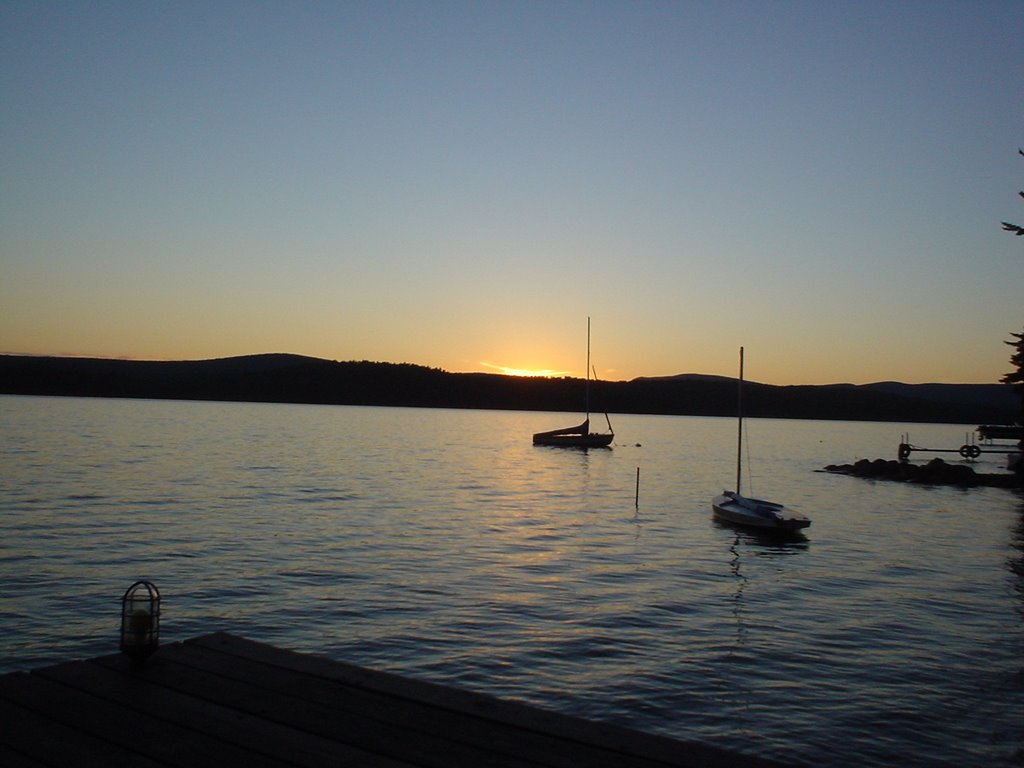
I heard someone say that she thinks of her life as how many summers she has left. How many? I don’t know but I want them all to be like this one.

 myfanwy collins