
by Myfanwy Collins
I was nineteen, maybe twenty, and setting up house with my boyfriend as I worked my way through school, bartending at night, studying and going to class during the day. We lived in an old farmhouse on a corner. When we looked to the south, we saw the mountains, to the west a pine forest, to the north a dirt road bordered by a field and a forest, and to the east our land—yielding a view of a garage (once a barn) and the grazing land of the sheep farmer next door. We tilled the soil back behind the garage. We didn’t even test it, didn’t need to. In this place, things always grew.
Our plot measured 20 by 50 feet. Maybe we bit off more than we could chew. But I was resolute. I wanted this garden. I would do it all myself if I had to.
We created raised beds because my boyfriend told me they were easier to weed. You just hoe in between the rows, he said. We planted everything we could think of—sunflowers, lettuce, radishes, carrots, dill, beans, squash, and tomatoes.
As the seeds gestated in their tidy beds, I hadn’t realized what I would feel—my heart. The seeds broke apart, reaching tiny fingers through the soil, hungry for light and moisture. These babies grew and, despite the weather, the black flies, and the mosquitoes, I worked in the garden every day, tending, weeding, watering, picking, plucking. As the plants grew, I realized that I could sustain life.

This is Darby with his new friend, Mae. We’re watching her for two weeks. Their favorite toy is this plush snake. I don’t know how we’ll ever let Mae go back home. We love her: 
An action shot (lots of faux growling and barking is taking place as well): 
Mae, up close and personal: 
And my lovely Darby with the ever-present snake: 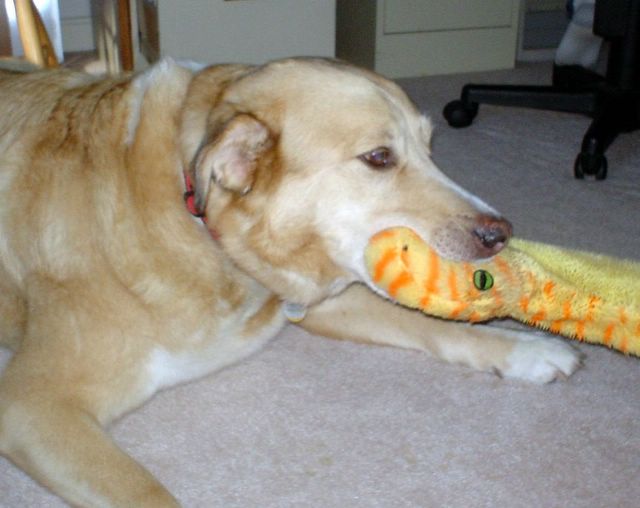
The multi-talented Robin Slick has a wonderful piece live right now at Slow Trains–1980: A Memoir About a Loss and a Win.

Great stuff–Small Spiral Notebook‘s Felicia Sullivan chats with Roxana Robinson:
The way that I write stories is quite different from the way I write novels. When I start a story, it’s because of a certain moment that I find particularly powerful. It can be one that I’ve witnessed, or heard of, or experienced myself, but for some reason it takes on a particular potency. That moment becomes the centerpiece of the story. My task then is to write toward that moment, creating the characters and the tension and the urgency and the engagement that will make the moment be as powerful for you, the reader, as it was for me, the writer, when you encounter it. It usually comes at the end of the story, and something else usually happens, too, something that I can’t predict.

Poetry by Priscilla Atkins–And Now, A Word from the Ghost of Eva Perón

Novelist, Richard Lewis has a great new blog. Go on and check it out: Reading James Joyce’s ULYSSES for the first time.

In the cover blurbs, the narrator of M. J. Hyland’s debut novel, How Light Gets In, is compared to Holden Caulfield. And surely there are some nods to Cather in the Rye but one might also compare it to The Sterile Cuckoo, The Bell Jar, The Moviegoer or any number of books (I would even argue that it shares similar themes to Anne of Green Gables) about one coming of age, awkwardly and with a brain too big for others to handle.
Lou Connor is fascinating and because she is fascinating, the book narrated by her recounting her time as an Australian exchange student living with a host family in a wealthy suburb of Chicago is fascinating. Lou comes from Sydney, where she left behind her alcoholic parents and evil older sisters. She is in America on a full-scholarship exchange. She received the scholarship because of her intelligence–and this intelligence is evident throughout.
More than the plot, though, what is so interesting is the character study of this young woman. One of the first things she tells the reader is what she knows about serial killers–that most of them were treated randomly as children. And then, throughout the rest of the narrative, she shows us how she was treated in a similar way, which may explain why she has a difficult time sleeping and why the touch of others leaves her cold.
She also (as do most teenagers) paints herself the victim in all situations–even those she has brought on herself. And when we might find ourselves tiring of her angst, she pulls through with another facet of herself (such as having a great singing voice) which makes us interested in her again.
Ultimately, we don’t know the truth of what happens to Lou. Throughout, her narration is unreliable and then when Lou prods the other exchange student to read the urgent letter from her mother and then tell her what it says, we are left with yet another layer of potentially unreliable narration.
I found this book engrossing in the same way I once blazed through Less than Zero and various and sundry other Bret Easton Ellis books–and that is that while I wanted to spend this time looking into Lou’s world, I’m extremely happy that I don’t have to live it.
So don’t judge this book by its cover and think that you are going to be reading yet another in a line of Holden Caulfield wannbes; Lou Connor is an original and her voice will bewitch you.
Oh bother. This news–Voices behind Tigger, Piglet die–has left me very sad. I love the old Winnie the Pooh (not those crappy ones they pump out now). And Piglet was one of my favorite characters.

Hearty (and heartfelt!) congratulations to Jordan Rosenfeld, who is has completed her MFA at Bennington. Way to go, Jordan!

Ordinary Springs, Florida is anything but ordinary. There are mysteries there. There is murder and betrayal. There are children abandoned and husbands gone mad. Ordinary Springs is pure Southern Gothic and above and beyond anything, it is also pure American small town. Where secrets don’t stay secrets forever and where rumors run the lives of its citizens.
Into this town is born Dory Gamble. After her mother abandons her when she is a toddler, her father raises her as best he can. This all works out well until the woman from New York moves in next door and her father is captivated by the soon to be widow.
Thus begins the coming of age of Dory Gamble. We watch her as she escapes from one horrible situation to the next and comes out all the stronger and more learned, until she ultimately finds true love and learns the truth behind the secrets that cloud her past–she is, in a sense, a modern day Tom Jones.
Told in unapologetically clear language, Lenore Hart’s Ordinary Springs is a tragic, gripping and, ultimately, satisfying examination of one girl’s climb into womanhood–so much of it similar to our own growing pains, or as Dory puts it:
Maybe sometimes it makes no difference that you’ve sworn never to make the same mistakes, never to repeat the old half-truths you were raised on. What did it all mean? Perhaps even fools are right, sometimes. I did cry then, because experience is such a hard teacher. And when would I ever get the lesson right?
Reading Barbara Sutton’s Flannery O’Connor award winning collection, The Send-Away Girl, is something akin to falling in love. At first, you might wonder about your attraction. Isn’t this voice sort of angry, strident? Should I really be liking these as much as I am? Hey, wait, this is not anger, this is not stridency. This is humor. This is intelligence. This is, above all else, empathy.
I didn’t fall in love during the first story, was worried that each one that followed would lead me farther down the path to mild like, instead I got sucked deeper and deeper into the vortex of this interesting, challenging mind–and the best thing is that the mind is challenging in a way that is accessible, i.e., the voice admits to being a fuck up. And what’s not to love about a fuck up, I ask you?
As a fuck up myself, I found great comfort in probably my favorite story of the collection, “Tenants”, which examines several layers of tenancy (an actual renter in the narrator’s sister’s property, a woodchuck under her mother’s garage, and her ex-boyfriend in her hall closet) and offers the wonderful insight into an other, younger version of myself, when I, too, had given up what I held dear:
Stopping was my default setting when it came to life. “Quitting” was probably a better word. Every activity of my current existence seemed to lead to this confession: I quit poetry. Yes, it’s true that I quit poetry, but that doesn’t mean the love was never there. I loved poetry so much, in fact, that I dind’t know what to do with it. The situation was very similar to my first encounter with that certain kind of white paste in kindergarten. I simultaneously longed to squish it between my fingers, eat it, and make love to it (though at that point I had no idea what “making love” meant). Poetry for me could never be a job; it was more like a unisex cologne that I’d want to smell on myself but also on some guy I loved–with the result that if I wore the stuff I could self-seduce. My problem, in a nutshell, is not that I didn’t love poetry. My problem is that I’m not that good at things.
Ah, sweet relief! To have a writer encapsulate several decades of your own pathetic Gen-X life in such a pure, perfect way is beyond compare.
Like the white paste, I want to squish this collection. I want to eat it, and make love to it.
It is brilliant and I hope not the last I’ll hear from Barbara Sutton.
Here’s my take in a nutshell: Buy it. Read it. You will not regret it.

Hmmmm… While this is certainly a nice prize it offers no vehicle for distribution, so it’s essentially a chance to have your book published via POD, which I’m totally fine with but I don’t know that “a new literary career” is being “launched” so much as a new POD venue is being launched.
In addition, there is no mention of who is judging this contest (none that I could find, anyway), thus it lacks a certain legitimacy for me. Not saying it’s not legit, rather do I want the good people of Xerox telling me whether my book is a winner or not? What are their criteria for choosing the “grand-prize-winning novelist”?
For what it’s worth, here’s the info:
You no longer have to be recognized by a major publishing house to produce a high-quality book.
In an effort to break down a barrier preventing millions from achieving their literary dreams, Xerox today launched its own “American Idol” for aspiring authors. The Xerox Aspiring Authors Contest aims to uncover the best unpublished novels and stop the cycle of rejection letters that keep so many from seeing their work in print. All entrants to the contest will receive one free paperback copy of their book digitally printed and fully bound.
The grand-prize-winning novelist will receive 100 published copies of his or her story, $5,000 in cash and a possible opportunity to launch a new literary career.

 myfanwy collins