
Just got this email from Jordan (and if I was in the area, I would definitely attend):
Creating Space: A One-Day Law of Attraction “Play-Shop” for Writers
Saturday September 24th, 11 a.m. to 4 p.m.
Sebastopol Center for the Arts, Library Room. 6780 Depot Street, Sebastopol.Now that the busy days of summer are winding down, take time to focus on your writing goals and desires. Attract the writing life you aspire to lead with writers Rebecca Lawton and Jordan E. Rosenfeld, co-authors of the forthcoming book: Creating Space: The Law of Attraction for Writers.
Writers of all genres and forms welcome.
Join the authors for a day-long “Play-Shop,” using games from their book designed to open channels, inspire creativity, and create the blueprints for the writing life you deserve.
Creating space for the writing life need not be hard; in fact Rebecca and Jordan invite you to experience how having fun is crucial to getting what you want.
The day will consist of two sessions, morning and afternoon, with a 1-1/2 hr writing assignment during lunch on your own in Sebastopol.
Course fee: $75 (includes instruction & materials).
Early registration: $65 for those who sign up by September 10th. Send your contact information with check made out to: Write Livelihood, 635 ‘E’ Street, Petaluma, CA 94952.For information: Rebecca Lawton, , or Jordan Rosenfeld.

If you haven’t been following along with Richard Lewis as he reads Ulysses for the first time, you really should. It’s good fun.

For your reading pleasure, please check out the fantabulous Robin Slick at Opium: Fly Casting

So, a guy I met at Squaw Valley (you are thinking: will she ever shut up about this place?) last year and again this year (though I didn’t get much of a chance to chat with him and that’s a shame because he seems like a cool guy and, based on the stories I’ve read of his, is a great writer) is a fiction editor at a beautiful journal called The Orange Coast Review. The journal is made up of fiction, poetry, and art (gorgeous, full-color, glossy art). I had a chance to read through it on the plane home and really enjoyed it because it is not only beautiful to look at but the content is superb.
In the past, they have specifically looked for writers and artists in their area but now are branching out to other locales. So, if you are interested, give the site a look (you have to click on the cover to get the flash version to pop up–there you can read excerpts and get submission guidelines) and maybe order a copy and/or submit some of your polished prose and/or poetry to them.

The weather has turned. No fan blowing on me for the first time in three months or so. Leaves are falling. Lilies dying.
It’s left me feeling a bit broken-hearted, a bit lost. A bit desirious of change, of moving somewhere fresh, of new things starting up, of back-to-school and soccer games played in the fading light.
A bit wishing it was June again and I had the long days ahead of me instead of behind me. I’m not ready for this winding down. Not ready for the long, dreary winter.
Perhaps I’m being premature. Maybe this turn is only temporary. Maybe I’ll wake up one morning and the sun will be there again.
Meanwhile, these three fictions by Girija Tropp are really, really nice. Go on and read them, why don’t you?

I’m sure by this point people are thinking, “Would she quit posting today, already?” Well, the answer is no. I will not. I’ve lots of lost time to make up for and it looks like next week is going to be a total bust as I will be in Topeka, Kansas all week (don’t ask!).
Okay, so just a few more things for today:
1) The unstoppable and incomparable Susan Diplacido interviewed one of my favorite people over at her blog. So go on and read it: Susan interviews Beverly Jackson. You will not be disappointed as both of these women are fascinating.
2) Speaking of Bev, check out the latest sampling from Ink Pot (which includes a gorgeous pastel of Bev’s. Who knew? She is a woman of many talents. Christ!).
3) I just want to give a shout out to the good people at Swivel and let you know that it seems they are opening for submissions again on August 15th (which is today! huzzah!). And I also want to let you know that if you haven’t purchased a copy of Swivel yet, do it now, Damnit (Dammit? how the fuck do you spell that, anyway? And does it require a capital? Please advise. Oh. And do I need an extra period outside the parens? or not? or what?).

I think what makes any experience all that much better is the people you share it with. And to come into a group of strangers, spend the week with them (and if you are in workshop with them, this means 18 hours), and get to know them and feel that you share something, is really quite special.
This past week I met some remarkable people and I’m grateful that they spent time with me. While most of the people were from the West Coast, there were some of us from the East and some from the Midwest as well. All in all, a great, well-rounded group of people.
I’ll admit that on my first day (last Saturday) when I was cranky from not much sleep the night before and tired from travelling, I felt immediately weary upon hearing everyone around me overzealously dishing on “craft” and “the writing process”, but my crankiness quickly wore off as the workshop heated up and the people around me started to show their distinctions.
And so what you learn is that calling Squaw a “community of writers” is not just a phrase tossed off and used lightly; what you learn is that it really is a community, despite what anyone might say. There is an attitude of one-ness, of helping, and of encouragement. And I don’t mean to sound so Pollyanna, but after two years of experiencing this workshop, I do believe in the community more than ever.
Okay, I’m going to shut up now because I think I have wrung this topic dry for now. But let me just say one more thing for you writers who might be reading this, if you are considering workshops for the future, I hope this is one you will put high on your list.
Part of the experience at Squaw is that each participant is alloted a one-on-one session (minimum of 20 minutes) with a staff member (a writer, an editor, or an agent). Last year I met with Andrew Tonkovich of the Santa Monica Review for an hour. He was absolutely great. Helpful, intelligent, generous with his time, and full of great suggestions for improvement. I revised the story we looked at and do feel that it is a lot stronger now.
This year, my one-on-one was with Dorothy Allison. As soon as I found that out, I was filled with excitement (Dorothy Allison!!!), dread (would she hate me and find my writing crappy and superficial?), and regret (oh how I wished I had sent another story!! I was so worried she would think it was stupid). To add to my anxiety, I was set to meet with her on Friday afternoon–the last day of workshop and also the day after she gave her mind-blowing reading.
Dorothy was absolutely encouraging, gracious, helpful, and didn’t find me stupid at all (at least not that she let on). It was a fantastic meeting and made me admire her even more, which I hadn’t thought possible. I don’t want to go into too much detail, but I do want to say that from my 30 minutes with her, I felt–for possibly the first time ever–completely validated as a writer.
And I have to say, that for me there is nothing better than that in this writing life. Nothing.

This is one helluva jam packed week. Last year, I went to EVERYthing and by the end of the week was ready to lie in bed and watch sitcoms. This time around I took a more moderate approach (thanks to Steph for urging me to get out and into the woods more this time around. Everyone needs a partner in crime and she was mine for sure. Great to have someone around who knows what’s important to you and shares those interests and so kicks you in the ass when you are not doing what makes you feel good) and went to those panels and readings which were new in comparison to last year.
Here’s a quick run down of what readings and panels I attended and my reaction to each:
Dorothy Allison on The Story Arc: I could go on and on about how fabulous she is. Seriously. And here she once again gave freely of her writing view. Essentially, her message was that story arc is personal to the writer. There is no formula.
Tom Jenks on The Importance of Time in Narrative Prose: He was an excellent speaker and this talk was a good one. He gave both specific and general ideas for how to establish and maintain time successfully within one’s writing. One of my favorite take-aways from this talk was in regards to pacing, about which Jenks said that the story needs to be synchronized with the reader’s sense of time.
Panel on the Short Story: moderated by Andrew Tonkovich, the panel consisted of–Michael Jaime-Becerra, Dagoberto Gilb, Elissa Schappell, Gregory Spatz, and Jay Gummerman. Provocative questions and answers. Unfortunately, I had to leave before the panel was over as I had to go to “Finding the Story.”
As far readings go, there were some great ones there as well. I didn’t go to all of them but quite a few. Here’s my run down:
Elissa Schappell read a great (funny, honest, sad) essay on her absinthe obsession. Loved it!
Gregory Spatz read a story about a fiddle contest. Michael Jaime-Becerra read an entertaining short story.
Gerald Haslam read a great piece in a truly entertaining way. Oh how I love when writers break out of the “reading voice” and give some power to their performance.
James D. Houston read a fascinating piece about Hawaii.
Jordan Fisher-Smith read an intriguing passage from Nature Noir.
Leslie Daniels read from her HILARIOUS (and amazing) Intimacy and the Feast.
Karen Joy Fowler (who is extremely funny) read from The Jane Austen Book Club (a book I have been wanting to read and now, after hearing Fowler, want to read for sure).
Dagoberto Gilb read an excerpt from a story and a non-fiction piece on pride. Both quite wonderful.
And, last but not at all least, Dorothy Allison gave a RIVETING performance (it was so much more than a reading) from her book in progress. You would be hard pressed to find a person in the audience who was not blown away. When I met with Dorothy the next day (more on this later), what I told her was that it was more than a reading, and it was more than a performance. I told her it was like God (even if you don’t believe in God). Wow. Was it something. Watch for this novel when it comes out. I don’t want to give away too much but I will tell you that to me, it sounds like it is going to break records and hearts. I cannot wait to read it.

 The daily workshop aspect of Squaw Valley Community of Writers is intense (to the left is a photo from the deck of the building where my daily workshop was held). Here’s how it works: each day, for six days, from 9am-12pm, you meet with your group (each group has 12 people, sometimes one or two more or less, but more often than not, exactly 12) and discuss writing (either a chapter from a novel or a short story) from two of the group members. Each piece of writing is meant to get about 1 1/2 hours (but factor in breaks and such and it works out to an hour or less) and every person in the group (except for the writer) should contribute with things they liked in the piece and possible places for improvement.
Each day, there is a new moderator for the group (either a writer, editor, or agent). This year, my group leaders were Joanne Meschery (she was enthusiastic, interesting, and gave us great handouts. I liked her a lot); Dorothy Allison (This woman is the epitome of generous. She came in and immediately became a part of our group–when we hardly even knew what to make of each other yet. And not only that, but she gave of herself and her knowledge freely. She is not only a brilliant writer but an amazing teacher as well. Here’s a quote from the day she moderated: “A writer writes a book, but a reader writes another book.”); Alan Cheuse (I had him for workshop last year as well. He’s interesting and intelligent. I loved his discussion about the books he’s reading.); Peter Steinberg (he is an agent at Regal Literary and was the leader the day my piece was up. He was extremely helpful and generous with his commentary. His suggestions not just for what I should improve in my story but for HOW I might go about doing it were spot on. He seems like a good guy.); Gregory Spatz (soft-spoken and humble, he had great insight into the writing being workshopped. On top of this, he is one hell of a fiddle player–but more on this later); Rob Spillman (he was our last day moderator. He not only gave helpful insight on the readings but also spent a good deal of time talking to us about how he came to work in publishing).
Along with the great moderators, the writers in my group were outstanding. Not only were their works interesting and varied in topic and tone, but these people were great, insightful (how many more times can I use that word in this post?) readers as well. I hope to keep in touch with many, if not all, of them. I was truly impressed with the level of discourse–though sometimes, as happens in groups, things would fall apart, but we were generally able to pull it back together. A couple of people in the group have books published already, which I hope to read in the coming months.
On top of this regular daily workshop, I also signed up for an additional hour long workshop each day called “Finding the Story”, which is a workshop run exclusively by its creator Gill Dennis. I don’t want to describe the process here because to experience is really to know it, but I will say that I formed equally special bonds with the folks in that workshop as we learned a lot about each other by hearing each other’s stories. It was intense and often folks would break down in tears during the course of hearing the stories but it was also revelatory–and for me, it doesn’t get much better than when something obscure is revealed to me. On top of this, Gill Dennis is just a fascinating and cool person and hanging with him and learning this process was a great experience.
I miss the people from both workshops. Some I felt more connected to than others, but each of them gave me something special by sharing their words, their world view, and their stories.

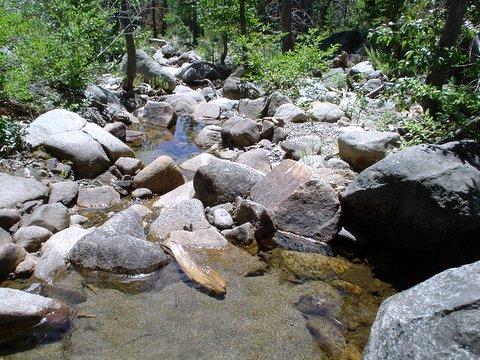 There’s a lot I have to say about last week (can it possibly be last week already? In the past? I want to keep feeling this way), but I don’t feel like I can put it all in one post. So, I will start out with the setting and some photos I took before my batteries died (and I was too busy to get new ones).
 In case you missed me raving last year, let me say once again that Squaw Valley is a place of stunning beauty. The valley itself is at 6,000 feet and the mountains surrounding it at 8,000+ (you can take a cable car to the top and hike even higher from there). So the air is thin but clear and there are still patches of snow visible on the high peaks. The surrounding woods are mostly pines–Jeffrey and Ponderosa. And there are also Aspen (one of my favorite trees). I don’t recall any other deciduous or evergreen.
 This year there was much more water than last year so things were a bit less dry. When Steph and I hiked up to Emmigrant Trail above high camp, we saw many wildflowers still in bloom (mostly Mule Ear). Just gorgeous! I wish there had been more time for hiking, but as it was, we got out about once a day. Mostly just part way up the trail behind the main lodge, where we found a gorgeous little stream with potholes. We spent a good deal of time sitting there with our feet in the water.
 From the deck of the condo, there were views of mountains and sky. I felt enfolded, embraced by the land.
 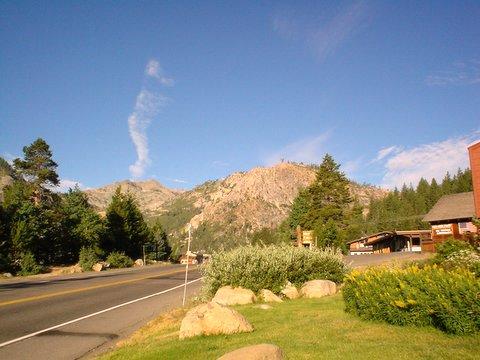 Every morning as I walked to workshop, I faced the mountain. In photos, it looks unreal. As though painted on a blue canvas. Perhaps this is because the air is so clear that the details seem larger than life. I don’t know.All I know is that I miss that mountain. I hope I will see it again sometime.
It’s no secret that Smokelong Quarterly is one of my favorite ezines. Once a year, Dave Clapper and his staff pulls all of the flashes into one big print annual. Here’s the info about the annual and how to purchase it:
SmokeLong Annual 2004-2005 is now available for sale. It’s currently available at cost (well, at CafePress’s cost), which is $15.04. We may raise the prices of both Annuals after writers have had a chance to get a copy.
There are 89 stories by (and interviews with) 78 writers in this year’s edition. 268 perfect-bound pages. Cover features miniature versions of each of Marty Ison’s covers from the past year.
SmokeLong Annual 2004-2005 can be ordered here.

 myfanwy collins