
Last year, the police came twice to the house with the pool. Now they are fighting again. He yells, “Fuck, the miniskirt. Fuck the fucking miniskirt.” They’ve moved back into the dark parts of house so as not to be heard. Her voice is sharp. His deep. She might have screamed. Maybe not. They are quiet now. In the autumn, the police had him down the ground. “Just do it,” he said. “I will kill them all.” The boys’ voices echo as they walk up the hill with peach cobbler for the elderly woman who lives next door. Her dog has passed away. The boys return and say that it is her birthday today and that she will put a candle in the cobbler. Thank you. The man at the house with the pool is mowing the lawn now. Her sharp voice is quiet.
I never open the north-facing window because then sound and smell from the exhaust fan overtakes my room. From mid-afternoon on they are down there working on the menu, the specials, and the fan mouths cooking smells in and pushes them back out. Mouths in and pushes out. Beneath the other window, a slice of the parking lot offers heels on asphalt and drunken voices long after I’ve gone to bed. They leave the restaurant below: He says, I will fucking kill you. She pulls along the pavement, scratching and scrabbling. The car doors open and shut. Muffled voices from behind steamed windows. And nothing. Sometimes I look out and see the tops of their heads but I do not recognize them. They are all a voice. One voice. They might as well be the sky.
I am IN LOVE with the cover for my young adult novel, THE BOOK OF LANEY, forthcoming from Lacewing Books in March 2015.
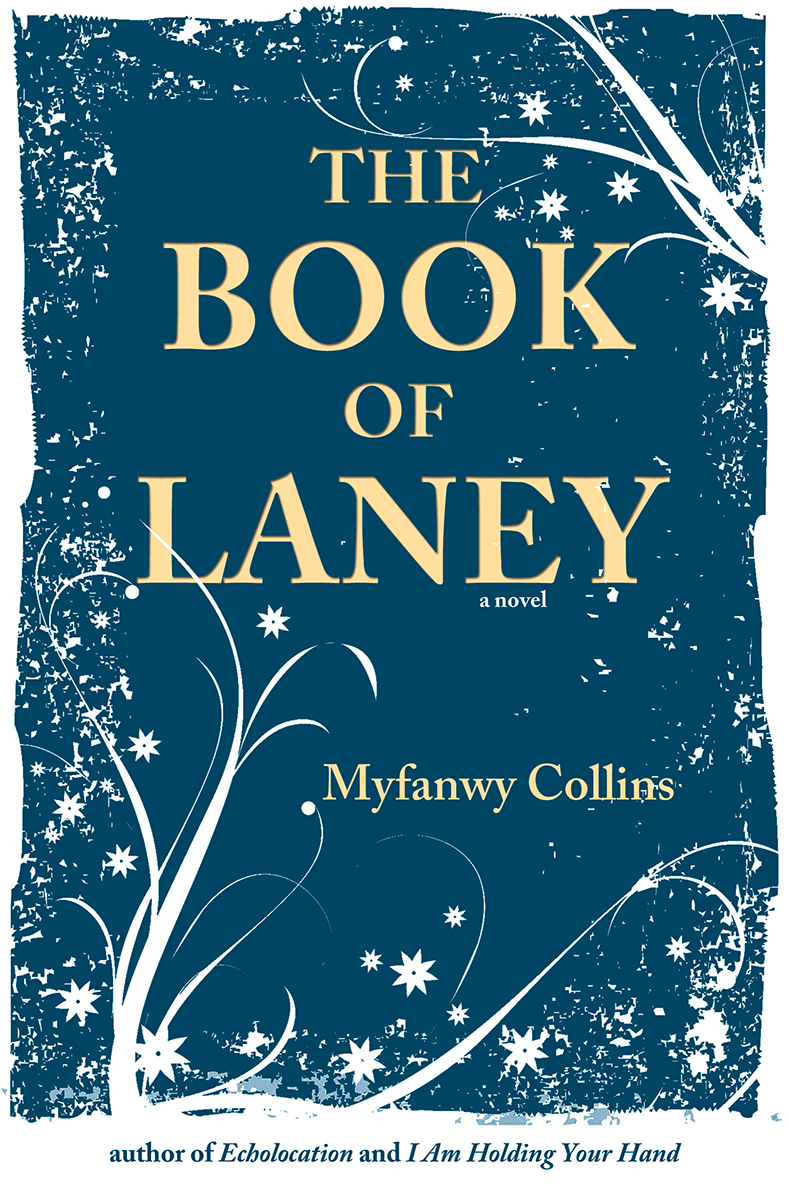
The Book of Laney
On July 12, 2000, my mother was diagnosed with inoperable lung cancer. We were given the news while she lay in her bed at Central Florida Regional Hospital in Sanford, Florida. I remember the date because it was my husband’s birthday and he was off by himself on the holiday we had planned together. I had not gone with him because a few days before we were meant to leave I got the devastating news that my mother was sick.
It was news that was both shocking and not shocking, as I had been waiting for it all of my life, as my earliest memories are those in which her life hung in the balance. Would this be the time he killed her? We clung to each other in the dark, listening and waiting and hoping it would not happen. Please do not let it.
Imagine a hunter is stalking you and it is dark and you know you’ve done nothing wrong. The fear is like that.
Imagine you are Trayvon Martin. Imagine that.
So when I hear Sanford, Florida in the news, I know Sanford, Florida. I have been there with you. I have sat on that bench outside the hospital and looked at the lake. I have seen the trumpet vine. I have snuck wine into my mother’s hospital room so that we could drink it together while we watched the first season of Survivor.
So, I want to tell you that Sanford, Florida is not all George Zimmerman. It is also Mary, who was my mother’s nurse for those nine months–on and off–that she stayed at the hospital. Mary took care of us all. She made sure we had sheets for the pull out chair. She and my mother teased each other. She knew my mother was a pain in the ass and she loved it. She loved her. I felt that love. She gave it freely. She was fearless in her love of someone who was dying. Someone she could not save, but didn’t give up on anyway.
For tonight, I’m going to remember Mary when I think of Sanford, Florida. I going to remember that there are people like Mary who care for those who are dying and have no hope. There are people who show compassion to the families of the dying. There are people who give you all of their own heart no matter what they have going on in their lives.
Tonight, I will remember Mary as a representative of Sanford, Florida instead of this man who took to the streets out of fear and anger. Who, under the guise of protecting his neighborhood, made so many of his countrymen feel unsafe and angry and afraid.
He protected nothing. He murdered a child and now he is free, but he does not, I hope, represent who we are, because we are also, Mary.
We must also give of ourselves freely and without fear. We must do this. We must do better.
The light was pulsating. The grass gleaming now that it was spring. It gleamed. The wind and the light gleamed.
“Gleam on, grass,” she said.
“Gleam on,” he son repeated. They drove on toward the store, her son looking out the window.
“Who is I, Mummy?” he asked.
“You are you and I am me. I is also the one who is singing the song. When I am singing, I am I and when you are singing, you are I. Does that make sense?” He met her eyes in the mirror, nodded.
“How can I ever explain I properly?” she asked. Her son said nothing, hummed. “Perhaps, I am a simpleton,” she said. “I. I. I.” And then another thought for I.
“I is for ice cream,” she said. “We must buy some. We must buy ice cream and milk and cream for Mummy’s coffee.”
“And ice cream,” he said.
She taught him the rhyme, watching his eyes in the rearview mirror: “You scream. I scream. We all scream for ice cream.”
“I scream,” he said. She smiled and winked at him as he bucked his legs up and down, excited.
At the grocery store, she unstrapped him from his seat, hugged him tight.
“Gleam on,” she said.
“Gleam on,” he repeated.
Give me my child, she thought, cradling his head in her hand. Let me take him in my arms and hold him. That is where we are best, when we are next to each other.
Your foot on my leg. Your hand on my face. Your breath in my nose.
His skull was small, narrow, but he did good work with his hands, digging up the earth, planting trees, teaching people how to conserve. We would forgive him his trespasses. We would remember that he had helped us plant our first garden. That he chopped our wood when we were cold. We would remember that he knew how to find his way out of the woods on a snowy night when all we could hear were the chains on the plows jingling in the distance like wind on bone.
The snow chips away. Slashes of wet and ice everywhere. No brown. No dried grass. There was a path of food coloring where she and the child pretended to leave bread crumbs. “Be quiet,” she whispered to him, “Don’t let the abominable snowman find you.” He’d been frightened then, wanted to go in. Not surprising. A sensitive child, he cried out each morning at 3:30, “Come to me, Mama. I’m scared. I’m scared.” She’d tried to distract his thoughts so they might stay in the cold air and tire out. “Look at the snow and how it sparkles.” She pointed up to the roofline. “Look how the light shines through the icicles.” The sun was low in the naked tree branches, burning its way west. But no, the sun does not move; we move. Her child’s eyes were on the path behind them, watching. She looked, too. There they were: the silver claws, the yellow teeth. The abominable snowman was nothing but a sandbox cover leaning up against the house, dusted with snow; the turtle’s eyes shone through, blinded by ice.
Her produce drawer was a mess of moldy tangelos. She bought the fruit on a hopeful day in early December just before the holidays sucked the life out of her, dumping her into the end of February with moldering drawer of uneaten citrus. It had been a winter of records–snowfalls, cold temperatures, wind speeds–leaving them trapped in the house when they otherwise might have been out walking. She liked to picture herself briskly pushing the stroller up the hill, the baby giggling. Birds singing. Snow sparkling. She sensed the baby was as anxious as she was, eager to push out of his mother’s arms and explore the world. Instead there were the same walls. The daily sounds–a dog’s bark, birds bickering at the feeder. The routine, always there, unbroken. The rhythmic thunk-thunk-thunk of the exersaucer. The mechanical music of the toys and the edgy-drama of her own voice reading the same favored books time and again. Remember this. Remember this. This is important.
It was mid-July and the Hydrangeas had not yet bloomed. Her mother would have told her to be patient. “They might be late bloomers,” her mother would have said. What she wouldn’t have said, but thought, was, “like you.” She was a late bloomer. That’s how she thought of herself, though the truth was that she had never bloomed at all. Oh, there might have been one dewy night in her 30s when she felt beautiful, but that was it. One night. Flowers were allowed to be late bloomers. People not so much. People were expected to excel and wow. Children needed be precocious or not bother at all. She had been neither a dull nor a brilliant child and she had been a clinger. Her mother had kept her home that extra year when she missed the kindergarten cut off by 29 days instead of lobbying for her to enter kindergarten as a four going on five. “You weren’t ready,” her mother said when asked. Her father had not been there. He was dead. Men just died. They were there and then they were not there. They were figments. They were filament. They were figurative. They were fire. Oh, how the wind blew strong and fast over the clam flats, bringing with it the salty smell of decay. All around town hydrangeas were blooming, blue and white and pink, while her own hydrangeas were nothing but clumps of leaves. Not late bloomers at all. Nothing but fire.
Oh, there was that family that visited from California. All that way. They brought their Breyer toy horses to the beach, those girls and their cousin. She tried to join in with her own horses but they were inferior, brandless. Later they teased her because she had grown breasts over the year since they’d seen her last, her bathing suit now too small, riding up. She waded into the water and kept her head under for ages. It didn’t matter now. There was no adult supervision. Those days were gone. Her mother was out of there. Her mother existed somewhere else. That was all that was known. Her mother was not there. That was all that was known. Her father never would be there again. Her father would have insisted on adult supervision. Left alone, the girls might die. As a young child, she had been scared, not of the water, but of the teenager helping her out to the deep water and the raft. No, no, no. Mama, mama. Her mother was somewhere, off on shore. Away and unreachable. Mama, mama. She thought of her mother on shore, a cigarette, a book. Maybe a cup of coffee. Her father standing there with a beer in his hand, watching. Supervising. But she did not call him. Mama, mama.
We followed a narrow drive lined by trees down to the house and the barn. The house was brick, covered over in plaster. The man with the fiddle and the man with the guitar stood in the entryway and played music. Can we get there? Can we get there? Yes. The cat rubbed up against the palms of our hands. We sat by the well and ate a dry crumb cake. The ponies were in the distance. The hay was being ridden. The plow was tearing up the field. The quarter horse stood and stared at us and flared his nostrils. That is how he breathes. He takes air in and breathes it out. The nostrils flap open and flap shut. His head was bigger than the baby’s body. The baby was almost three and liked to make jokes. How did the pretzel cross the road? To get to the other side. Back home, there were the birds in the bird bath. There was my wrinkly skin. There was Charlotte’s Web. No, there was a spring day with blossoms and there was Charlotte’s Web on a bed in sunshine. There was the front stoop and there were the flowers drying in their pots. There were the hydrangeas that never bloomed. There was a week of rain. There were the birds who complained. Or maybe they were happy. It was impossible to distinguish their happiness from their cries of distress.
The sun came out and everything looked brand new. The azaleas were blooming bright red and pink, salmon and purple. Their shades always just a little bit off. The heat settled in, moss on a rock. People weren’t used to it anymore. They wore sweaters to work in the morning and by noon were rolling up their sleeves and wiggling their toes in heavy socks. Everyone was uncomfortable with the heat, though they welcomed it. A cold had been going around. A lung-based cold. Lots of uncontrollable coughing. Later in the day, the sky darkened and people wondered what was to come. The sky. The sky. What do birds do in a tornado? How do they escape? Or do they? Is it their rapture? Are they carried up? Are they thrown down? Oh birds, what do you do? How do you escape? Where can you go, birds? Where? Please come back and we will protect you. We will find a place where you are safe.
 myfanwy collins